
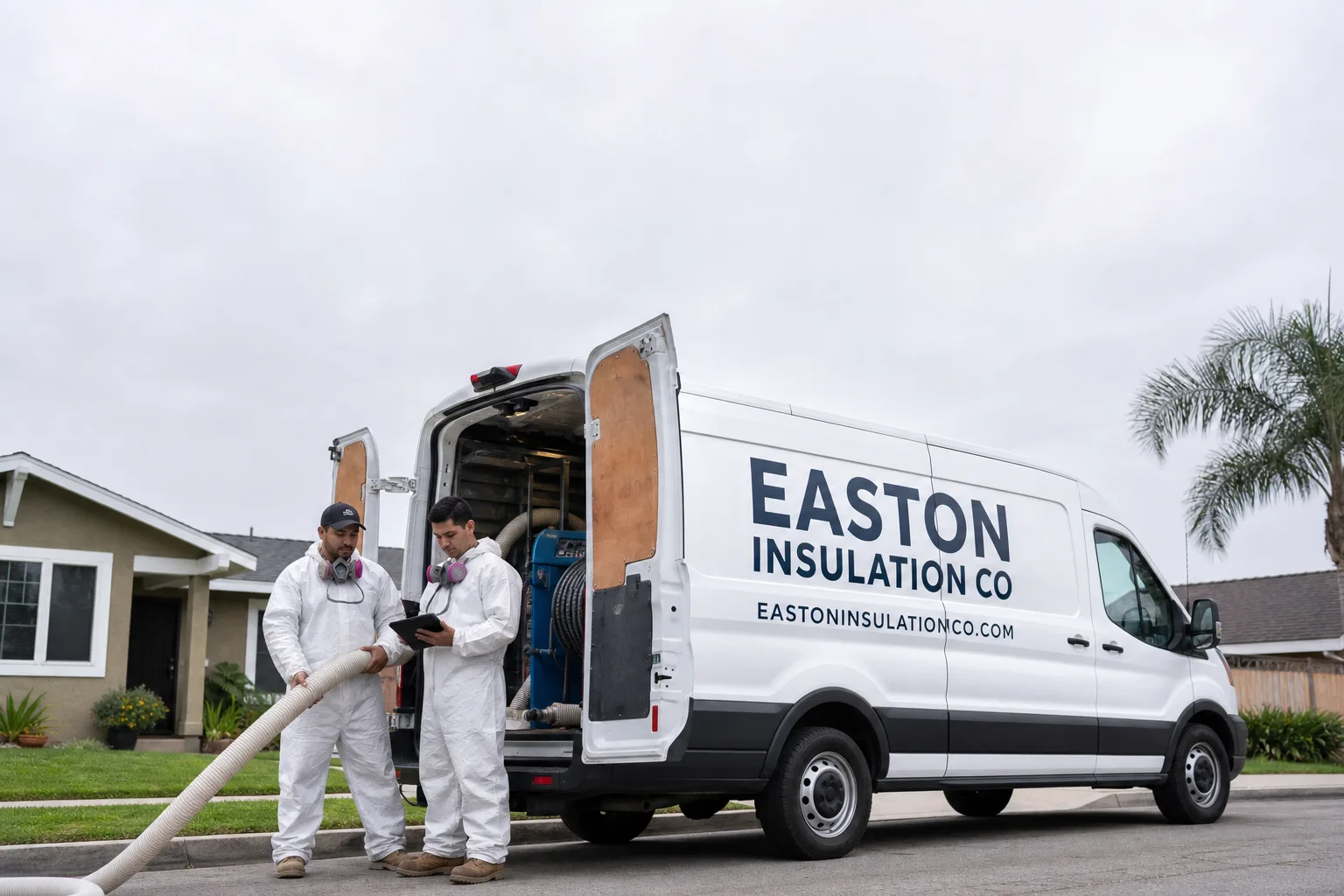
Spray Foam Insulation in Brea: Which Side of the 57 Are You On?
Spray foam insulation in Brea breaks into two distinct jobs, and the answer depends on which side of the 57/60 freeway interchange your house sits. Canyon-edge homes in 92823, where Carbon Canyon wind and direct north-county sun hammer roof decks, need closed-cell foam on the underside of the sheathing to stop radiant gain and wind-driven air infiltration. Flatland tract homes in 92821, built mostly from the 1950s through the 1970s, typically need careful removal of compacted fiberglass batts followed by open-cell or hybrid spray foam work around aging ducts in low-clearance attics. Our Spray Foam Insulation team runs both approaches daily across Brea, and we’ll tell you honestly which one your house needs. Call (833) 467-6922 for a free attic inspection and a straight answer.
Fast, Reliable Spray Foam Insulation Across Brea
Brea isn’t one housing market, and it isn’t one insulation problem. We work in the 92821 flatland tracts off Imperial Highway, the newer foothill builds in 92822, and the canyon-edge homes in 92823 where Carbon Canyon Road climbs toward the hills. That split matters because a spray foam recommendation that’s right for a 1960s rancher near the Brea Mall is wrong for a hillside home backing Tonner Canyon. We know which houses carry original 2×4 rafter construction, which ones have cathedral ceilings that complicate roof deck work, and which flatland attics have barely enough clearance to crawl through, let alone retrofit. When you call, we can usually get a crew to Brea within a day or two, and for attic inspections we’ll work around your schedule. Call (833) 467-6922 and tell us which part of Brea you’re in.
Why Easton Insulation Co Is Brea’s Preferred Spray Foam Insulation Company
Noel Carrasco runs our spray foam work, and he’s the one who walks Brea attics before any foam gets sprayed. The difference shows in the details: we don’t sell one foam type for every house, we don’t foam over failing material to save time, and we don’t skip the top-plate sealing that matters on canyon-mouth exposures. Brea homeowners tend to find us because a neighbor’s house stayed cooler after we worked on it, or because their AC bill refused to drop even after they replaced the unit. We earn that trust the hard way, by inspecting first and recommending only what the house actually needs.
Easton Insulation Co is an authorized installer for eight manufacturer brands across four insulation categories: Owens Corning, Johns Manville, Knauf, Rockwool, CertainTeed, Icynene, Demilec, and GreenFiber. For spray foam specifically, we work with Icynene and Demilec, two professional-grade product lines that require specialized training and equipment. That’s not a marketing point, it’s a capability signal: the same company that can quote closed-cell on a canyon roof deck can also quote blown-in cellulose for a flatland attic. We’re never locked into pushing one product because we carry all of them. For Brea’s split housing stock, that matters.
Open Cell Spray Foam in Brea
Open Cell Spray Foam in Brea is our go-to for the older 92821 tract homes where attics are tight, ducts run through unconditioned space, and the original fiberglass batts have compressed into something closer to paper. Open-cell foam expands to about three inches per pass, seals air gaps well, and it’s forgiving in low clearance because you don’t need the thick monolithic layer a closed-cell roof deck demands. It also stays vapor-permeable, so if an older Brea flatland home has minor roof seepage or shared wall moisture, the assembly can still dry instead of trapping water behind an impermeable barrier. That’s a real consideration in 1950s and 1960s construction where the original roof decking and flashing have lived through sixty-plus Southern California summers.
Typical open-cell work in a Brea flatland attic runs $1,100 – $2,900 for partial coverage, and a full 1,200-square-foot attic retrofit usually lands between $3,800 and $6,500 depending on ceiling height, access, and how much old material needs removal first. Closed-cell runs higher, typically $2.00 – $3.50 per board foot for rim joist and band-joist sealing, and $2,700 – $7,400 for a full roof deck application on an average Brea canyon-edge home.
When the Attic Has Old Batts and Aging Ducts
We pull the old material, every time. Open-cell sprayed over compacted fiberglass batts traps moisture, hides gaps, and leaves the ducts buried under layers that don’t perform. In a tight 92821 attic where ductwork runs through the conditioned boundary, removing the old batts first and then air-sealing the top plates before foaming is the sequence that actually moves the needle.
Cathedral Ceilings in 92822 Foothill Builds
Homes in 92822 that climb toward the hills often carry cathedral ceilings or vaulted spaces with no attic floor to work from. Open-cell injected into the rafter bays works there, but the application has to be planned around access and venting. We’ve done enough of these in Brea’s foothill tracts to know what the framing allows before we quote anything.
Spray Foam Insulation Contractors in Brea
Spray Foam Insulation Contractors in Brea aren’t all equipped the same way, and the difference shows up fastest on canyon-edge work. Closed-cell foam on a 92823 roof deck needs a professional rig, the right Demilec or Icynene product spec for the deck’s exposure, and a crew that knows how to build the right thickness without overshooting and gluing the baffles shut. The wind-driven infiltration at the Carbon Canyon and Tonner Canyon mouths means the top plates and wall-to-deck transitions have to be foamed completely, not just eyeballed from below. That’s where a general handyman with a foam kit fails, and where a trained contractor earns the call.
We apply closed-cell at two inches minimum on Brea roof decks with canyon exposure, and we seal every seam before we consider the job done. The failure mode we see most often on existing foamed decks in 92823 is thin application: the foam was shot to cover the wood, not to stop the radiant load, so the attic still runs hot by mid-afternoon and the canyon wind still finds the unsealed edges. Happens more than homeowners think, especially on homes foamed a decade ago under looser code expectations.
Canyon Wind and Top-Plate Sealing
Santa Ana wind doesn’t need a big opening. A one-eighth-inch gap along a top plate on a canyon-mouth home will push hot, dry air through the wall cavity on every wind event, and the homeowner feels it as a room that won’t hold temperature. We foam top plates on every Brea canyon-edge job, not because it photographs well but because skipping it leaves the job half done.
Closed-Cell Roof Deck Work in 92823
The sun-exposed hillside homes off Carbon Canyon Road and the Tonner Canyon edge need closed-cell on the roof deck specifically, not open-cell. Closed-cell’s R-value per inch is higher, but the real reason is air-sealing and structural drying resistance under a roof assembly that bakes in direct north-county sun. Open-cell on that same deck lets radiant heat through and gets wind-washed. Wrong product, wrong house.
Trusted Brands We Service in Brea
We’re an authorized installer for Icynene and Demilec spray foam products, and we stock the materials for both open-cell attic retrofits and closed-cell deck work. Having two professional-grade foam lines means we’re not married to one manufacturer’s thickness tables or coverage assumptions; a Brea flatland attic and a Brea canyon roof deck can each get the product that fits the job. That flexibility matters on Brea’s split housing stock, where a 1958 tract home and a 2005 hillside build called for different approaches. We also carry Rockwool and CertainTeed across our broader insulation work, so if spray foam isn’t the right answer for a specific cavity or budget, we’ll say so and quote what is.
Common Spray Foam Insulation Problems We See in Brea Homes
- Closed-cell sprayed too thin on 92823 roof decks. The foam covers the sheathing but doesn’t stop the radiant load, so the attic still heats up by mid-afternoon and the canyon wind whistles through the unsealed seams. We re-inspect these and almost always add two inches of proper Demilec or Icynene closed-cell to fix the thermal and air-sealing failure.
- Open-cell foamed over old fiberglass batts in 92821 low-clearance attics. Someone skipped the removal step to save time, and now the foam has trapped moisture against the old batts and hidden the gaps over aging ductwork. A proper fix means pulling the foam and the batts, then starting fresh with clean deck and top plates.
- Skipped top-plate sealing on canyon-mouth homes. The wall cavities look sealed from below because the foam covers the obvious gaps, but the top plates were never foamed, so Santa Ana wind-driven air moves through every wind event. Homeowners on Carbon Canyon and Tonner Canyon edges feel it as rooms that won’t hold temperature no matter what the thermostat says.
- Foam applied over failing original batts without air-sealing the ceiling plane first. In older Brea tract homes, the attic floor is full of wiring penetrations, recessed light cans, and duct chases. Foam over that without sealing the plane just buries the leaks under new material. We seal the plane first, then foam.
Pricing for Spray Foam Insulation in Brea, CA
Open-cell attic work in Brea’s 92821 flatland homes typically runs $3,800 – $6,500 for a full 1,200-square-foot attic, including old batt removal and top-plate air-sealing. Closed-cell roof deck work on 92823 canyon-edge homes runs higher, usually $2,700 – $7,400 depending on deck area and rafter depth, and rim joist or band joist sealing in either part of Brea lands around $2.00 – $3.50 per board foot. What moves the price: attic clearance, how much old material needs pulling, whether the roof deck is accessible from inside or needs scaffolding, and how much top-plate detail the canyon wind exposure demands. Call (833) 467-6922 for a free estimate, and we’ll give you a number tied to your house, not a brochure range.
We Also Serve Cities Near Brea
Our crews cover Brea and the surrounding north Orange County area, including Placentia, Fullerton, Yorba Linda, and La Habra. If you’re in one of those cities and need the same canyon-edge versus flatland evaluation, the same brands, and the same crew, call (833) 467-6922. We’ll come out, inspect, and tell you what your house actually needs.
Serving Brea, CA — Our Local Coverage Area
We’re based in the Brea area and know this community well. Use the map below to see our service coverage — if you’re nearby, we can almost certainly help.
FAQs About Spray Foam Insulation in Brea
Closed-cell, every time, on the roof deck. Your 92823 canyon-edge home sits in direct north-county sun with Carbon Canyon wind pushing against the walls, and closed-cell is what blocks the radiant load and seals the wind-driven infiltration. Open-cell on that same deck lets heat through and gets wind-washed. Call (833) 467-6922 and we’ll inspect your deck before quoting.
No, and you shouldn’t let anyone do that. Old fiberglass batts in a 92821 attic are usually compacted, dusty, and lying over an air-leaky ceiling plane. Spraying open-cell over them traps moisture against the old material and hides the real gaps over your aging ducts. We pull the batts, seal the plane, then foam. Call (833) 467-6922 for an inspection and an honest sequence of work.
Yes, and it does it through gaps you can’t see from inside the attic. The Carbon Canyon and Tonner Canyon mouths funnel hot, dry wind against the wall-to-deck transitions, and any unsealed top plate or rim joist lets that air move through the wall cavity on every wind event. Foam that covers the obvious gaps but skips top-plate sealing looks fine from below and fails under wind load. We foam top plates on every canyon-edge Brea job for exactly this reason.
Yes, but the mechanism is air-sealing plus thermal resistance, not just R-value. Brea’s inland north county climate bakes attics most of the year, but overnight drops and canyon influence mean winter drafts also move through the same gaps. Closed-cell on a 92823 roof deck stops radiant gain and winter wind-driven loss at the same time; open-cell in a 92821 attic seals the ceiling plane so your ducts stop cooking in summer and your rooms hold heat when it’s cold. Call (833) 467-6922 for a free attic assessment and we’ll show you where your house is losing either way.
Low clearance, old ductwork, compacted and sometimes damp batts, and rafter spacing that doesn’t match modern insulation assumptions. Many 92821 tract homes have attics you can’t stand in, with ducts running through the conditioned boundary, and foam work there needs careful sequencing and a lot of patience. On 92823 canyon-edge homes, the complications are different: cathedral-ceiling rafter bays, limited access, and sun-exposed decks that demand full closed-cell coverage, not just spot treatment. If you’re in an older Brea home, the best first step is an inspection: call (833) 467-6922.
One Reason to Call Us Before You Foam in Brea
On a canyon-mouth home off Carbon Canyon Road in 92823, our crew found the underside of the roof deck baking in the afternoon sun and the original batt in the rafters sagging away from the sheathing. We pulled the loose material, sealed the deck and rafter bays with Icynene closed-cell foam, and foamed the top plates where hot canyon air was being pushed through wall cavities on wind events. The homeowner reported the upstairs bedrooms stopped gaining heat through the ceiling by mid-afternoon, which they had fought for years with the AC running nonstop. That’s the job, done right, on a house that needed the canyon-edge approach, not the flatland one. If your Brea house sits on the canyon side of the 57/60, call (833) 467-6922. We’ll tell you what we’d do before we spray anything.
Written by Noel Carrasco, Owner at Easton Insulation Co, serving Brea and north Orange County since day one.