
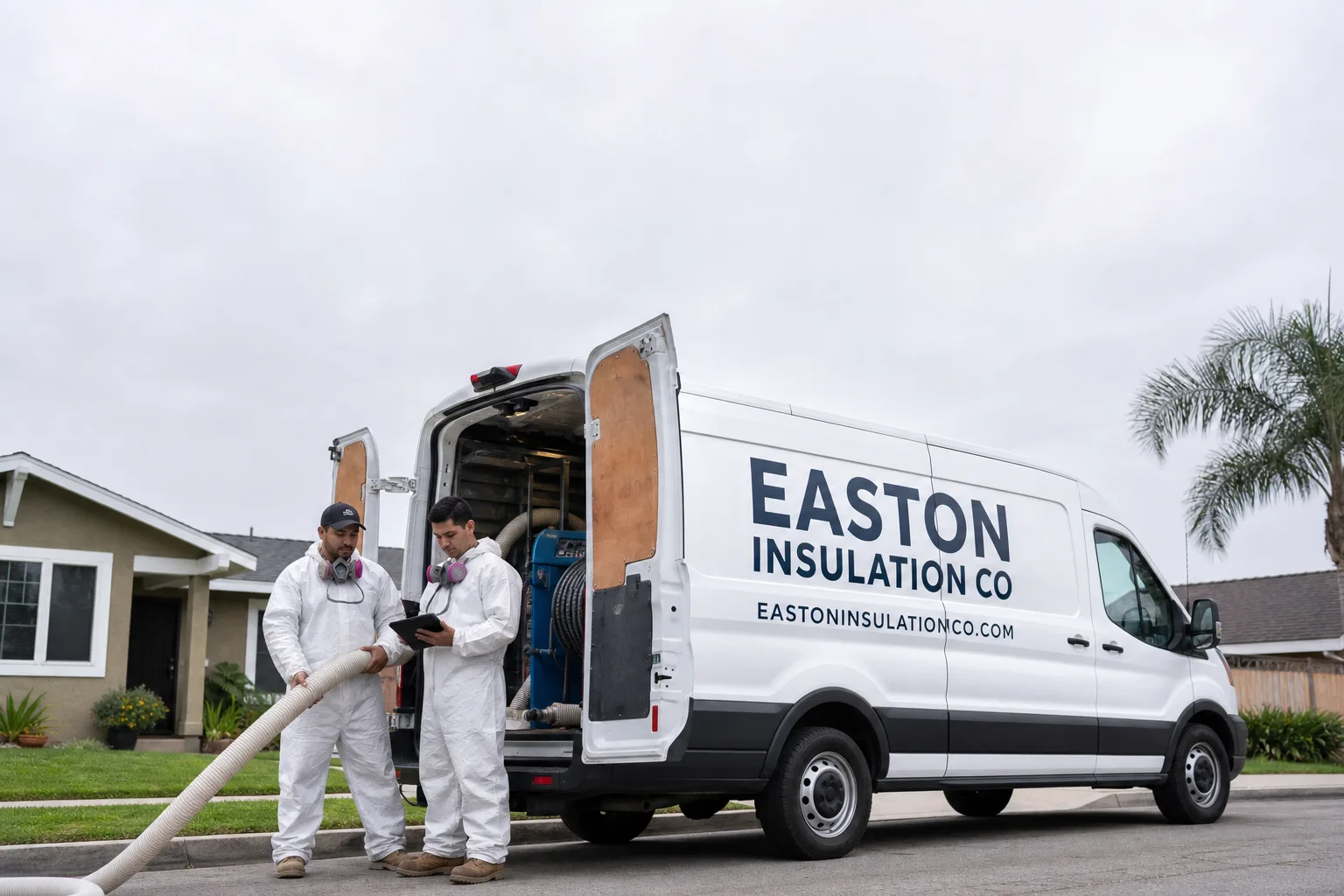
Fast, Reliable Spray Foam Insulation Across Fountain Valley
Spray foam insulation in Fountain Valley is rarely a blank-slate job. It’s an upgrade layered into a 1960s or 1970s tract home that still has its original R-11 kraft batts, a shallow 2×4 attic, and air leaks most contractors never bother to find. That’s the work we do every week in ZIP codes 92708 and 92728. If you’re tired of upstairs bedrooms that bake during a Santa Ana event or a cooling bill that climbs every August, call us at (833) 467-6922. We’ll inspect what’s actually in your attic and tell you straight what closed-cell or open-cell foam can and can’t do for your house.
Why Easton Insulation Co Is Fountain Valley’s Preferred Spray Foam Insulation Company
Fountain Valley’s housing stock is a single-decade build wave. Nearly every home went up between 1965 and 1975, which means the same framing, the same attic access quirks, and the same original insulation failures show up house after house. Our crews know these homes before the ladder goes up. We know the west-side tracts near the 405 where attic hatches hide in bedroom closets and baffle-free soffit vents let blow-in drift over the eave line. That means fewer surprises mid-job and a cleaner install. Noel Carrasco runs every project with the same expectation: the foam goes where it’s supposed to, the air seal is real, and the homeowner understands exactly what was done and why.
We’re an authorized installer for eight manufacturer brands, and for spray foam specifically we work with Icynene and Demilec, two professional-grade systems that require dedicated training and calibrated equipment. Fountain Valley homeowners call us because the estimate is specific and the crew shows up already familiar with the house type. Response time to most Fountain Valley addresses is same-week, and during peak summer heat we prioritize calls from Fountain Valley because we know how fast a west-facing second story turns into an oven.
If you want to know how the foam will actually perform against Fountain Valley’s dry fall Santa Ana heat, call (833) 467-6922. We’ll walk your attic with you if you want, show you what’s there, and give you a quote grounded in what we can see, not a sales script.
Closed Cell Spray Foam Insulation in Fountain Valley
Closed cell spray foam insulation in Fountain Valley is the air-seal workhorse on these 1970s tract frames. It’s a rigid, moisture-resistant foam with an R-value near R-6.5 per inch, and on a typical 2×4 ceiling cavity it creates the thermal and air barrier in one pass. In Fountain Valley’s shallow attics, where depth is limited and the existing R-11 batts are compressed or collapsed, closed-cell gives you the most thermal performance per inch while sealing the exact leak paths original construction left behind: recessed can lights, closet attic hatches, drywall seams, and top plates.
A closed-cell job on a Fountain Valley attic floor typically runs $2,800 to $5,400 depending on square footage and how much prep the original batts need. If the batts are dusty and collapsing, they have to be pulled or prepped first. Foam sprayed over them will not bond, and you’ll get adhesion failure and trapped moisture inside the assembly. We say that on estimates because it’s the most common reason we’re called in to fix another contractor’s work in this city.
When closed-cell is the right call
Fountain Valley homes with existing blown cellulose or kraft-faced batts in the attic floor are the most common candidates. Closed-cell foam locks the thermal boundary and air barrier at the drywall plane, which matters when the attic is vented and you’re trying to keep 130-degree Santa Ana heat from radiating into the bedrooms. For rim joists and garage ceiling applications, closed-cell is the default choice because it handles moisture exposure far better than open-cell.
The venting problem we catch too late
West-side tracts near the 405 were built with eave vents and no baffles. If foam or blow-in drifts over the soffit line, it blocks airflow and turns the attic into a moisture trap. We cut in rafter baffles at every soffit before spraying, then air-seal the original penetrations. Skipping that step is how you get a $5,000 foam job that works worse than the old batts.
Open Cell Spray Foam in Fountain Valley
Open cell spray foam is the quieter, lighter-density option we install in Fountain Valley when the goal is air sealing plus acoustic dampening without the full rigidity of closed-cell. It runs about R-3.7 per inch, expands aggressively to fill irregular cavities, and is often the better fit for vaulted ceilings, interior wall cavities, and garage ceiling applications where you want sound control alongside thermal performance. In Fountain Valley, where most homes sit close together and the 405 hum is constant on the west side, that acoustic benefit is real, not a brochure bullet point.
Open-cell on a Fountain Valley garage ceiling or attic knee wall typically runs $1,900 to $3,600. It’s not the product for rim joists or any surface that sees moisture, and on our estimates we mark that clearly. For attic floors in this city’s tract homes, we often pair open-cell with a GreenFiber cellulose top-off, using the foam as the air seal and the cellulose as the cost-effective R-value layer.
The right place for open-cell in a 1970s tract home
If you have a bonus room over the garage or a converted attic space, open-cell fills the irregular framing cleanly and cuts noise transfer from the garage and street. On bedroom walls facing Talbert or Magnolia, open-cell in the wall cavities noticeably reduces road hum, and it’s straightforward to install during a remodel or re-pipe.
Why we quote both, not one
Most Fountain Valley attics don’t need a single product. They need a layered answer: air seal at the drywall line, then depth on top. That’s why we install Icynene and Demilec spray foam alongside GreenFiber cellulose and mineral wool from Rockwool and Knauf. The materials get matched to the house, not to whatever we happen to stock that month.
Trusted Brands We Service in Fountain Valley
Spray foam is a specialty within a specialty. The equipment is expensive, the chemistry is finicky, and the install quality separates a warranty that holds from a foam shell that peels. We install Icynene and Demilec because both systems have a long track record, local distributor support, and product data we can show you. For Fountain Valley’s original-batt retrofits, we keep a working stock of the common prep materials: rafter baffles, can light covers, and air-seal products. That means the crew doesn’t pause mid-job to chase parts across Orange County. When the foam goes in, it goes in clean and complete, same visit.
Common Spray Foam Insulation Problems We See in Fountain Valley Homes
Fountain Valley’s single-decade tract stock produces the same four failure patterns on nearly every retrofit. Here’s what we find when we walk an attic:
- Collapsed original R-11 batts left under fresh foam. The kraft facing gets dusty and brittle after 50 years, and closed-cell won’t bond to it. We remove or prep the old material before spraying, or the foam peels and the air seal fails.
- Baffle-free eave vents blocked by blow-in or foam drift. Homes west of the 405 were built with open soffits and no baffles. Without blockers, insulation slides over the eave line and chokes attic ventilation. We cut in baffles at every soffit before any product goes down.
- Closet attic hatches left unsealed. The hatch is an uninsulated hole in the thermal boundary. In Fountain Valley, those hatches are often in a bedroom closet, and they leak conditioned air year-round. We air-seal and insulate the hatch frame as part of every foam job.
- Original recessed can lights air-sealed from above. Old can lights are open to the attic. Foam around them is fine if done properly with a rated cover, but direct foam over an energized old can is a fire hazard. We install covers first, then foam.
If any of these sound familiar, we’re the crew to call. We see them every week in Fountain Valley attics.
Pricing for Spray Foam Insulation in Fountain Valley, CA
Fountain Valley spray foam pricing tracks the square footage of the attic floor or wall cavity, the prep the surface needs, and the foam type. You’ll pay more for closed-cell than open-cell, and more for a 1970s attic that still has collapsing original batts than for a newer rough-in. A closed-cell attic floor seal on a standard single-story 1,400-square-foot Fountain Valley tract home runs $2,800 to $4,600. A full open-cell garage ceiling and rim joist package lands between $1,900 and $3,200. Where we fall in the range depends on what we find when we open the access hatch.
We give written, line-item quotes before any work starts. Estimates are free, and we never charge for a second visit to verify scope. Call (833) 467-6922 for a number specific to your house. You’ll get a real price, not a “we’ll see” number.
We Also Serve Cities Near Fountain Valley
If you’re a Fountain Valley homeowner with a family member or rental in a neighboring city, our Spray Foam Insulation crews cover the full corridor: Midway City, Huntington Beach, Costa Mesa, and Westminster. Same crews, same eight-brand material access, same prep-first install standard. For projects closer to home, we’re always available here in Fountain Valley.
Serving Fountain Valley, CA — Our Local Coverage Area
We’re based in the Fountain Valley area and know this community well. Use the map below to see our service coverage — if you’re nearby, we can almost certainly help.
FAQs About Spray Foam Insulation in Fountain Valley
No, and you shouldn’t let anyone tell you otherwise. Closed-cell foam needs a clean, dust-free surface to bond. Fifty-year-old kraft-faced batts are dusty, sometimes moldy, and the kraft paper creates an adhesion break. We remove or fully prep the old batts before spraying. In some homes we leave the batts in place and spray the drywall line from the attic floor, but that’s a specific technique, not a shortcut. Call (833) 467-6922 and we’ll tell you what your attic actually needs.
Your closet attic hatch is a hole in the thermal boundary, and in Fountain Valley it leaks conditioned air twelve months a year. If we air-seal the attic floor but skip the hatch, the foam is working against a pressure leak you can feel. We always price hatch sealing into our quotes. If a contractor doesn’t mention it, they haven’t walked your attic.
Yes, on every soffit line. Fountain Valley’s original tract homes were framed with eave vents and no baffles. Foam or blow-in that drifts over the soffit blocks ventilation and turns the attic into a moisture trap. We cut in baffles before any product goes down. It’s not optional.
Yes, more than any other material per inch. During September and October Santa Ana events, Fountain Valley attics hit 130 degrees or more and radiate heat into the bedrooms below. Closed-cell foam on the attic floor stops that radiant transfer at the drywall line. You’ll feel the difference in the upstairs rooms within a day or two of the install.
We install Icynene and Demilec spray foam, both professional-grade systems. We’re not tied to one manufacturer, which means the product gets matched to your home’s needs, not to what’s cheapest in the warehouse. For a free estimate on your Fountain Valley attic, call (833) 467-6922.
If your Fountain Valley attic hasn’t been touched since the Nixon administration, it’s time for a real answer. We’ll show you what’s up there, what it’s costing you, and what closed-cell or open-cell foam will actually do. Call Easton Insulation Co at (833) 467-6922 and get a written estimate. No pressure, just the facts from a crew that knows these homes by frame and by block.
Written by Noel Carrasco, Owner at Easton Insulation Co, serving Fountain Valley spray foam customers with open-cell and closed-cell installs across 92708 and 92728.