
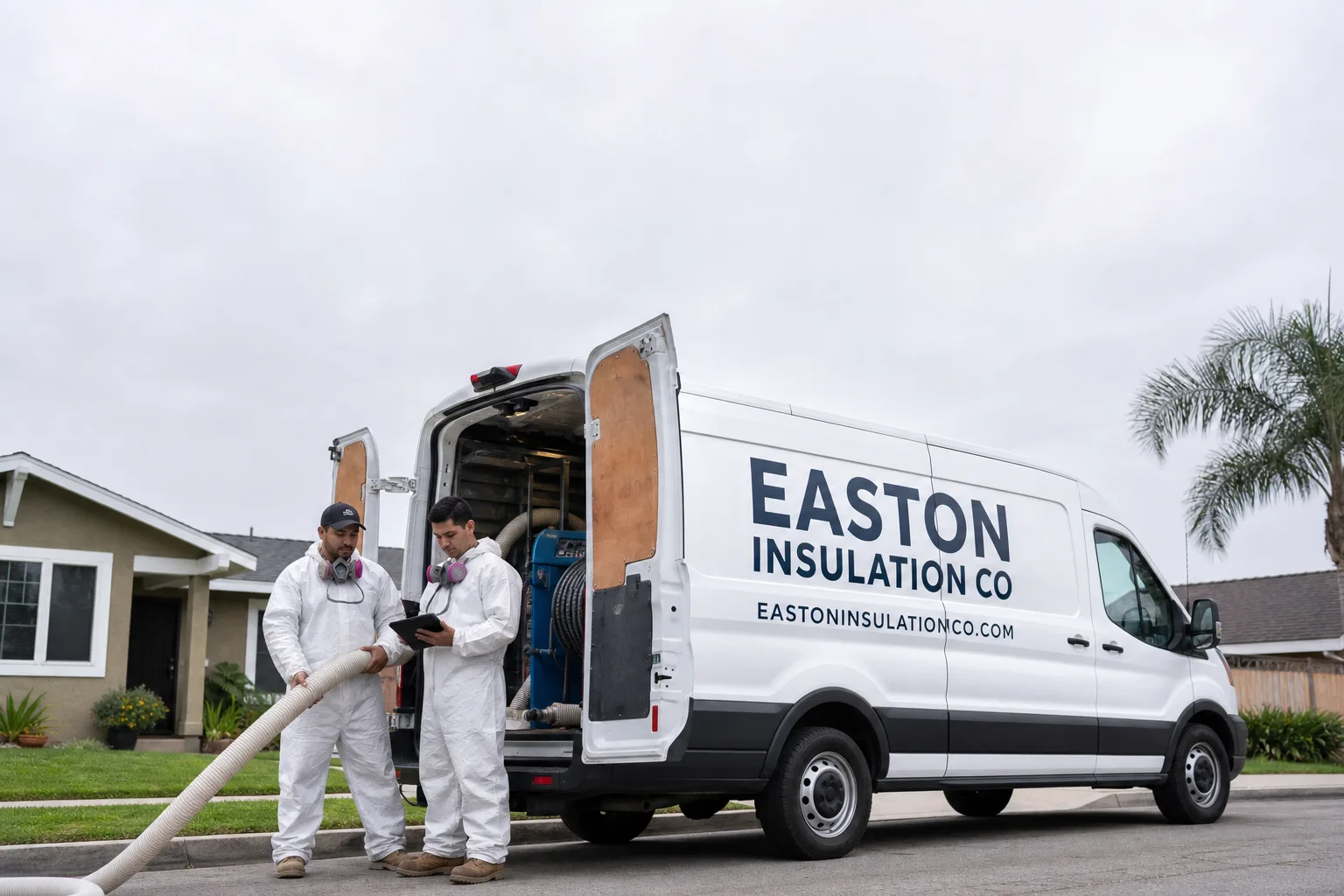
Fast, Reliable Spray Foam Insulation Across Santa Ana
Spray foam insulation in Santa Ana typically costs $2.50 to $6.50 per square foot depending on whether you choose open-cell or closed-cell, and most single-room jobs like a garage ceiling or rim joist run $900 to $2,800. The reason foam matters more here than in most cities is simple: our hot, dry Santa Ana wind events push attic temperatures past 120°F, and older Santa Ana homes were never built to handle that kind of heat load. When you call (833) 467-6922, you’ll talk to someone who knows the difference between a 1940s stucco bungalow in Washington Square and a 1990s tract home in South Coast Metro, because the foam approach for each is completely different.
Our Spray Foam Insulation team works in Santa Ana weekly, and we carry two professional-grade foam systems: Icynene open-cell for interior cavity and sound-dampening work, and Demilec closed-cell for high-moisture crawl spaces and rim joists. That matters because a crawl space under a 1930s bungalow near French Park has entirely different needs than an attic deck in a newer Fountain Valley-adjacent subdivision. The right material depends on the house, not on what one manufacturer happens to sell.
Why Easton Insulation Co Is Santa Ana’s Preferred Spray Foam Insulation Company
Easton Insulation Co is led by Noel Carrasco, and our approach to Santa Ana work is shaped by the housing stock here. We’re not a one-product shop pushing foam onto every house we see. We install eight manufacturer brands across four insulation categories, so when we recommend spray foam, it’s because the home’s specific situation calls for it, not because it’s the only tool in the truck. That’s a distinction most Santa Ana homeowners appreciate once they’ve talked to two or three contractors.
Our familiarity with Santa Ana’s older neighborhoods matters a lot in practice. Homes built in the 1920s through 1950s, which make up a large share of Washington Square, French Park, Floral Park, and much of central Santa Ana, were constructed with uninsulated wall cavities between stucco and interior plaster. That’s a foam retrofit scenario most contractors never see in newer cities. We see it multiple times a month. When you call us about a hot upstairs bedroom or a garage that bakes in the afternoon sun, we’re already thinking about the wall cavity profile, the attic configuration, and whether historic-district rules apply before we even arrive.
Response time for Santa Ana calls is typically same week, and emergency attic heat gain issues during Santa Ana wind events get priority scheduling. Noel Carrasco personally reviews specs on jobs where historic-district compliance is a factor, because those projects hinge on getting the scope right the first time.
Crawl Space Spray Foam Insulation in Santa Ana
Crawl Space Spray Foam Insulation in Santa Ana is one of the highest-ROI foam applications we do here, especially on the raised-foundation bungalows that dominate the pre-1950 housing stock. A typical crawl space foam job in Santa Ana runs $1,400 to $4,200 depending on square footage, access height, and whether we’re sealing the rim joist, the subfloor, or both. That range reflects what we actually quote on houses from Floral Park to the neighborhoods east of Main Street.
The job involves sealing the rim joist cavities and often the subfloor with closed-cell foam, typically Demilec, which handles the moisture conditions under a raised foundation better than open-cell would. On an older Santa Ana home, the crawl space is where hot exterior air infiltrates the floor system and where cool conditioned air escapes, so sealing it has an outsized effect on afternoon comfort in summer months.
Rim Joist Sealing on Raised Foundations
The rim joist is the horizontal band running around the perimeter of the house between the foundation and the first floor framing. On 1920s to 1950s Santa Ana homes, those cavities were never insulated, and the gaps around them act like vents pulling 100° to 120°F outside air under the house. Closed-cell foam cut and installed in each bay stops that pathway completely. This is not a job for a handyman with a foam kit from a box store; it takes professional equipment to reach confined access points under low-clearance Santa Ana bungalows.
Moisture Management Under Uninsulated Bungalows
Santa Ana’s coastal-influenced climate means cool marine air can push under a raised foundation and condense on floor framing, especially during June gloom months. Closed-cell foam at the rim joist and subfloor acts as both an air seal and a vapor retarder, which keeps that moisture from wicking into the old growth fir joists common in pre-1960 framing. If we see signs of existing moisture damage during a crawl space estimate, we’ll flag it before recommending foam, because foaming over active moisture problems makes them worse.
Garage Spray Foam Insulation in Santa Ana
Garage Spray Foam Insulation in Santa Ana is the fastest way to reclaim a garage that’s become unusable during summer afternoons, and it typically costs $900 to $2,400 for a standard two-car garage ceiling. Santa Ana’s stucco garages, especially those attached to older bungalows, transfer heat directly into the living space during late-afternoon peak temperatures, and the garage ceiling is often uninsulated or has a thin layer of failed batt insulation.
When we foam a garage ceiling in Santa Ana, we’re usually working in a space that was never designed with insulation in mind: open rafter bays, exposed electrical runs, and doors that haven’t been weatherstripped in decades. Open-cell Icynene is our go-to here because it fills the odd-shaped rafter cavities and seals around the framing gaps that let hot attic air pour down into the garage. For garages below conditioned rooms, the difference is noticeable within the first afternoon after the foam cures.
Garages Below Bedrooms and Bonus Rooms
Many Santa Ana homes have a bedroom or converted bonus room directly above the garage, which means the garage ceiling is also the floor system of a living space. In those cases, the hot garage air isn’t just making the garage uncomfortable, it’s radiating upward into the bedroom. Sealing the garage ceiling with spray foam breaks that heat pathway at its source. We see this configuration constantly in Washington Square and Floral Park bungalows where original floor plans put a sleeping porch above the garage.
Attached Garage Air Sealing
The wall shared between an attached garage and the house is another overlooked heat pathway. On older Santa Ana homes, that wall cavity is often open to the garage at the top plate or through electrical penetrations, which lets 120°F garage air bypass the wall insulation entirely. A thin layer of closed-cell foam at the shared wall’s penetrations and top plate closes those bypasses without needing to open the wall. It’s a small job with an outsized effect on the rooms adjacent to the garage.
Trusted Brands We Service in Santa Ana
We install and maintain spray foam from two professional-grade brands: Icynene and Demilec. Those are not names you’ll find at the hardware store; they’re contractor-line products that require manufacturer training and certification to apply correctly. We also carry Knauf and Rockwool mineral wool and CertainTeed fiberglass, because a Santa Ana home sometimes needs a hybrid approach: foam at the critical air-seal points, and mineral wool or batts where fire resistance or budget matters. Carrying all of them means we stock the right material for the job instead of forcing one brand into every situation. Noel Carrasco’s position is simple: recommended material follows the house, never the other way around.
Common Spray Foam Insulation Problems We See in Santa Ana Homes
- Thermal bypasses around crowded attic HVAC equipment. Santa Ana attics are often low-pitch and crammed with furnace units, duct runs, and old wiring. Foam installed without sealing around those penetrations leaves 120°F air a direct path into the living space. We seal penetrations before or during the foam pass, not after.
- Uninsulated 1920s – 1950s wall cavities behind stucco. These walls were built empty: two-by-four framing, plaster on the inside, stucco on the outside, nothing in between. Foaming them from the interior is the only viable option in historic districts where exterior work is restricted.
- Historic-district scoping conflicts in Washington Square and French Park. Foam jobs scoped from the outside routinely run into review constraints that protect the original stucco profile. We plan for interior-cavity and attic-only approaches from the start, which saves Santa Ana homeowners the cost of re-scoping a job mid-permit.
- Moisture management in old wall cavities. Foaming an uninsulated 1930s wall cavity without accounting for interior moisture can trap condensation against cool plaster in summer. We assess window type, interior humidity, and existing vapor movement before recommending open-cell versus closed-cell in wall cavities.
Pricing for Spray Foam Insulation in Santa Ana, CA
Here’s what we actually quote for Santa Ana work. Crawl space spray foam runs $1,400 to $4,200. Garage ceiling foam runs $900 to $2,400. Rim joist sealing alone runs $500 to $1,500. A full attic deck on a 1,200-square-foot bungalow runs $2,800 to $5,800 with open-cell, or $4,200 to $7,200 with closed-cell. What moves the number: access height in the crawl space, how much existing insulation has to be removed first, whether the job is interior wall cavities or open attic, and whether historic-district review adds paperwork. Estimates are free, and the number we quote is the number on the invoice. No change orders for conditions we could see during the walkthrough. Call (833) 467-6922 to schedule one.
We Also Serve Cities Near Santa Ana
If you’re in Tustin, North Tustin, Fountain Valley, or Orange and need spray foam work, we cover those areas too. Our Spray Foam Insulation in Santa Ana service area extends across the 92701, 92703, 92704, 92705, and 92707 ZIP codes, but we schedule jobs in the surrounding cities on the same routing. Call (833) 467-6922 and we’ll tell you which day we’re in your neighborhood.
Serving Santa Ana, CA — Our Local Coverage Area
We’re based in the Santa Ana area and know this community well. Use the map below to see our service coverage — if you’re nearby, we can almost certainly help.
FAQs About Spray Foam Insulation in Santa Ana
No, interior spray foam applications do not require historic-district review because they don’t alter the exterior appearance of the home. The restrictions in Washington Square and French Park apply to changes that affect the visible stucco profile, roofline, or street-facing elevation. We install foam from inside the wall cavities and attic, which means the exterior finish stays exactly as it was. Call (833) 467-6922 if you’re in a historic district and want to confirm scope before you start.
Yes, and Santa Ana attics are famous for this problem. The foam goes on the underside of the attic deck, not on the equipment, so the approach is to work around the HVAC unit, duct runs, and wiring. The key step is sealing the penetrations around those items first, otherwise hot attic air bypasses the foam layer through the gaps. We do both the sealing and the foam pass in one visit, and the equipment stays functional throughout.
Yes, and this is why material selection matters so much in Santa Ana. A high winter R-value measures resistance to conductive heat loss, which is a minor concern in our climate. The Santa Ana wind problem is radiant heat gain and air infiltration through unsealed cavities, and spray foam addresses those because it seals as it insulates. Closed-cell foam, in particular, acts as an air barrier and a vapor retarder at once, which is what a 120°F attic actually needs.
Yes, the moisture question has to be answered first. Old stucco homes with single-pane windows and no original vapor management can trap condensation on interior wall surfaces if foam is applied without considering how moisture moves through the assembly. We evaluate the window type, interior humidity levels, and existing plaster condition before choosing open-cell versus closed-cell for cavity work. Interior-cavity foaming on historic homes is routine for us, but it’s not a blind spray-and-go job.
For most pre-1960 Santa Ana bungalows, yes, and those two spots are usually the best starting point because they target the biggest air leaks in the envelope. A raised-foundation crawl space lets hot exterior air under the entire house, and a garage ceiling bakes the rooms above it every afternoon. Sealing those two areas typically delivers a bigger afternoon comfort improvement per dollar than a full wall cavity project. Call (833) 467-6922 for a free estimate and we’ll walk the house with you and point out which spots are leaking conditioned air.
Written by Noel Carrasco, Owner at Easton Insulation Co, serving Santa Ana and surrounding Orange County cities.