
Fast, Reliable Spray Foam Insulation Across Portola Hills
Spray foam insulation in Portola Hills typically runs $2,100 to $5,400 for a typical attic knee wall and rim joist package on a 1980s tract home, with most jobs completed in a single day. Homes in the 92610 ZIP sit on graded hillsides above the 241 toll road, where afternoon sun exposure and Santa Ana wind events push attic temperatures far beyond what flatland Orange County neighborhoods experience. Easton Insulation Co serves Portola Hills with spray foam crews who know the difference between a standard attic job and one that has to double as ember protection near Cleveland National Forest. Call (833) 467-6922 for a free estimate, and we’ll give you a straight answer on whether open-cell or closed-cell foam fits your home.
Why Easton Insulation Co Is Portola Hills’s Preferred Spray Foam Insulation Company
We’re not a single-product shop pushing one foam brand on every home. We work with Icynene and Demilec spray foam systems, which means the recommendation you get is driven by your Portola Hills house, not a manufacturer’s catalog. Homes along Saddleback Ranch Road or off Limestone Canyon Road have different exposure patterns than townhomes tucked into the lower slopes, and the right foam density and application thickness changes accordingly.
Our crews understand what 1980s and 1990s tract construction actually looks like inside the attic: original R-13 and R-19 batts that have sagged, radiant barriers that were never installed or have degraded, and vaulted ceilings that make knee-wall access tight. When we spray foam in Portola Hills, we’re rarely working with a clean slate. We’re working around thirty to forty years of accumulated dust, old wiring, and framing that was never designed for modern air-sealing. That experience is the difference between a foam job that performs and one that just fills space.
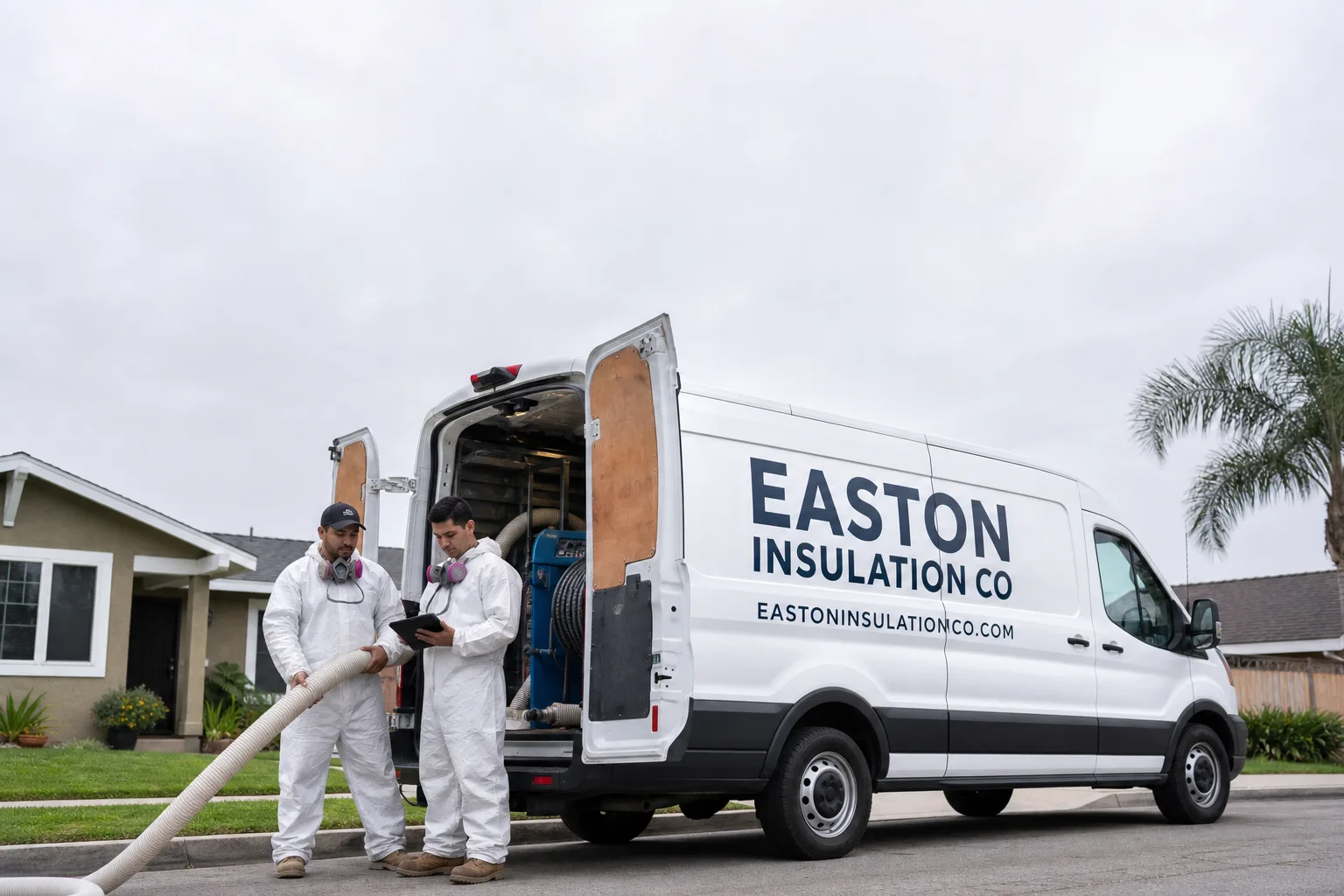
Led by Noel Carrasco, our team treats every Portola Hills attic as its own project. We don’t send a general crew to guess. Spray foam requires specialized rigs, temperature and humidity monitoring, and installers who understand the chemistry of two-component foam in hot inland conditions. In Portola Hills summers, ambient attic temperatures regularly exceed 140°F before we start. Foam applied incorrectly in those conditions won’t adhere properly, and we’ve seen the failed results from other contractors: voids, shrinkage, and foam pulling away from the decking.
Spray Foam Wall Insulation in Portola Hills
Spray foam wall insulation in Portola Hills is the most effective fix we install for the temperature imbalance between upstairs and downstairs rooms, a problem we hear about constantly from homeowners in the hilly sections of the 92610 ZIP. In a two-story Portola Hills home with stucco exterior and wood-frame construction, the wall cavities were typically built with minimal or no insulation in the 1980s, and what was installed has often settled. We spray open-cell Icynene or Demilec foam into exposed wall cavities during remodels, or use injection methods where drywall remains intact. A typical Portola Hills wall insulation retrofit runs $1,800 to $4,200 depending on accessible square footage.
Knee Walls and Vaulted Ceiling Cavities
Knee walls are the short vertical walls that separate a finished attic room or upstairs bedroom from the unconditioned attic space. In Portola Hills, where vaulted ceilings and two-story plans are standard in the 1980s and 1990s tracts, these knee-wall cavities are chronically under-insulated. We spray closed-cell foam to a depth that seals the thermal boundary and air-seals the assembly in one pass. The result is a room that stops leaking conditioned air into the attic through every electrical penetration and drywall seam.
Exterior Wall Air Sealing During Renovation
When a Portola Hills homeowner opens a wall for a kitchen remodel, window replacement, or room addition, that’s the window to spray foam the exterior wall cavity properly. We’ve worked on stucco homes off Alta Vista and along Saddleback Ranch Road where the original fiberglass batts had gaps around plumbing and electrical boxes. Closed-cell foam fills those gaps and bonds to the sheathing, adding structural rigidity that matters on a hillside lot. Expect to pay $2,800 to $5,500 for full exterior wall foaming on a typical single-story Portola Hills addition.
Rim Joist Spray Foam in Portola Hills
Rim joist spray foam is the single highest-value air-sealing job we perform in Portola Hills homes, and it’s the one most homeowners have never heard of until their energy bills arrive. The rim joist is the horizontal band board where your floor framing meets the foundation wall, and in Portola Hills tract homes, it’s almost always uninsulated or stuffed with sagging fiberglass. We spray two to three inches of closed-cell Icynene or Demilec foam along the entire rim joist line, which costs $900 to $2,400 for a typical Portola Hills two-story home. The payoff is immediate: conditioned air stops leaking out of the basement or crawl space, and unconditioned air stops being drawn in with every gust of wind.
Crawl Space Rim Joists on Hillside Lots
Portola Hills homes on graded slopes often have vented crawl spaces where the rim joist is exposed to the elements. The air that enters through those rim joist gaps on a hot August afternoon is the same air that makes your upstairs floors feel warm. We seal the rim joist band with closed-cell foam and, where appropriate, pair it with air sealing of the crawl space penetrations. On a hillside home off Glenn Ranch Road, this is often the difference between a crawl space that behaves and one that feeds humidity and heat into the living space year-round.
Garage Rim Joist Connection to Living Space
Many Portola Hills floor plans have a garage under or adjacent to the main living level, and the rim joist between the garage ceiling and the floor above is a prime leak point. We routinely spray foam the garage rim joist during whole-home air-sealing projects. It keeps exhaust fumes and temperature swings in the garage from migrating into the bedrooms above. This is also where we catch air gaps around the garage-to-attic access that rarely get sealed by other contractors.
Trusted Brands We Service in Portola Hills
We’re an authorized installer for Icynene and Demilec spray foam, which means we’re not tied to one manufacturer’s spec. When a Portola Hills homeowner asks whether open-cell or closed-cell is right, we can answer honestly because we install both. For homeowners who want a hybrid approach, we also carry Rockwool mineral wool and CertainTeed fiberglass, so foam isn’t the only answer we sell. We maintain a stock of standard foam components locally, which means a typical Portola Hills spray foam job doesn’t wait on parts shipped from a warehouse. We arrive with the right material for the job, not whatever’s left in the truck.
Common Spray Foam Insulation Problems We See in Portola Hills Homes
- Foam sprayed over old batts or radiant barriers. In 1980s tract attics off Saddleback Ranch Road and Limestone Canyon Road, we regularly find original fiberglass batts that were never removed before a previous contractor sprayed foam over them. The foam bonds to the dusty batt surface instead of the decking, and within a year it’s sagging. You can’t fix that by spraying more foam; the old material has to come out first.
- Ember entry through unsealed attic vents. Because Portola Hills sits in the wildland-urban interface near Cleveland National Forest, any attic vent without ember-resistant screening is an open door for wind-driven embers during Santa Ana events. We routinely see foam jobs where the thermal work is fine but the venting is still wide open.
- Thin foam in vaulted ceiling and knee-wall cavities. Two-story Portola Hills plans with vaulted ceilings create tight spray angles, and some contractors respond by spraying too thin. The cavity looks filled from the access point, but the back third of the space is bare. That void becomes a thermal bypass that undoes the rest of the job.
- Closed-cell foam on dirty framing. Portola Hills attics collect thirty years of dust, and foam won’t bond properly to a dirty surface. We prep every surface before spraying, and we’ve re-done jobs where the foam peeled off the framing in sheets because someone skipped that step.
Pricing for Spray Foam Insulation in Portola Hills, CA
Here’s what you can expect to pay in the 92610 ZIP. Rim joist spray foam in a Portola Hills townhome or tract home runs $900 to $2,400. Attic knee wall and vaulted ceiling foam on a two-story home runs $1,800 to $4,500. Full attic floor removal, air sealing, and foam application runs $3,000 to $7,500 depending on square footage and whether we’re removing old batts. Exterior wall foaming during a remodel runs $2,800 to $5,500. The biggest cost drivers are access difficulty on hillside lots, the amount of old insulation that has to be removed, and whether the job involves vaulted ceiling cavities that require extension wands and specialized rigging. Call (833) 467-6922 and we’ll give you a written quote after a walkthrough. Estimates are free, and we’ll tell you if foam isn’t the right choice for your home before we ever quote a price.
We Also Serve Cities Near Portola Hills
Easton Insulation Co regularly works in Foothill Ranch, Lake Forest, Laguna Woods, and Laguna Hills. If you live in any of these nearby cities, the same crews that handle Spray Foam Insulation in Portola Hills are available for your project. Call (833) 467-6922 and tell us where you’re calling from.
Serving Portola Hills, CA — Our Local Coverage Area
We’re based in the Portola Hills area and know this community well. Use the map below to see our service coverage — if you’re nearby, we can almost certainly help.
FAQs About Spray Foam Insulation in Portola Hills
Yes, when installed correctly. Spray foam creates an air seal that reduces the number of gaps and penetrations where wind-driven embers can enter, but the foam itself doesn’t do all the work. In Portola Hills, which sits in the wildland-urban interface next to Cleveland National Forest, the real benefit comes from pairing closed-cell foam with ember-resistant vent screening and intumescent sealing around penetrations. That combination closes the entry points embers actually use during Santa Ana wind events. We recently sprayed closed-cell foam along the rim joists and attic knee walls of a 1980s tract home off Limestone Canyon Road, where original R-13 batts had sagged and ember screens were missing. After sealing penetrations with intumescent caulk and installing ember-resistant vent screening, the homeowner reported attic temps dropping by 15°F during Santa Ana events. Call (833) 467-6922 for a fire-hardening assessment alongside your insulation quote.
Yes, in most cases. We access vaulted ceiling cavities from the attic side, which means we don’t need to remove the drywall below. The exception is when the cavity is too tight to reach from above. In those Portola Hills homes, typically the 1980s two-story plans with steep rooflines off Saddleback Ranch Road, we may need a small access opening. We’ll tell you upfront which approach your house requires, and we won’t start cutting until you’ve approved the plan.
Closed-cell foam is the right choice for rim joists in Portola Hills townhomes. It provides a vapor barrier, adds structural rigidity, and bonds tightly to the framing, which matters in attached-wall construction where air movement between units is common. Expect to pay $900 to $2,400 for a townhome rim joist job, depending on how many linear feet of joist we’re sealing. Call (833) 467-6922 for an exact quote on your unit.
Spray foam performs well in Portola Hills summers because it’s an air seal, not just thermal insulation. When the ambient temperature outside hits the high 90s and your attic hits 140°F, fiberglass batts rely on still air to resist heat transfer, and loose-fill fiberglass doesn’t stop the stack effect. Closed-cell foam stops the air movement itself, which is the mechanism that matters most in the long, dry heat Portola Hills gets from June through October. Homes we’ve spray foamed consistently hold 10 to 15 degrees cooler upstairs during peak afternoon sun.
Yes. Hillside homes off Glenn Ranch Road and Limestone Canyon Road often have attics you access through a narrow scuttle in a hall closet, with rooflines that slope steeply and limited headroom. We run professional spray foam rigs with heated hose systems, and our installers use extension wands and respirator-rated PPE to reach knee walls and vaulted cavities from awkward angles. This is not a job for a general handyman with a two-part foam kit from a hardware store, and we’ve re-done enough poorly applied DIY foam in Portola Hills to say that with confidence.
If you’re ready to talk about spray foam for your Portola Hills home, call Easton Insulation Co at (833) 467-6922. We’ll ask a few questions about your house, schedule a walkthrough, and give you a written estimate. No pressure, no product push – just a straight answer from someone who works with eight brands and isn’t married to any of them.
Written by Noel Carrasco, Owner at Easton Insulation Co, serving Portola Hills and surrounding Orange County communities.