
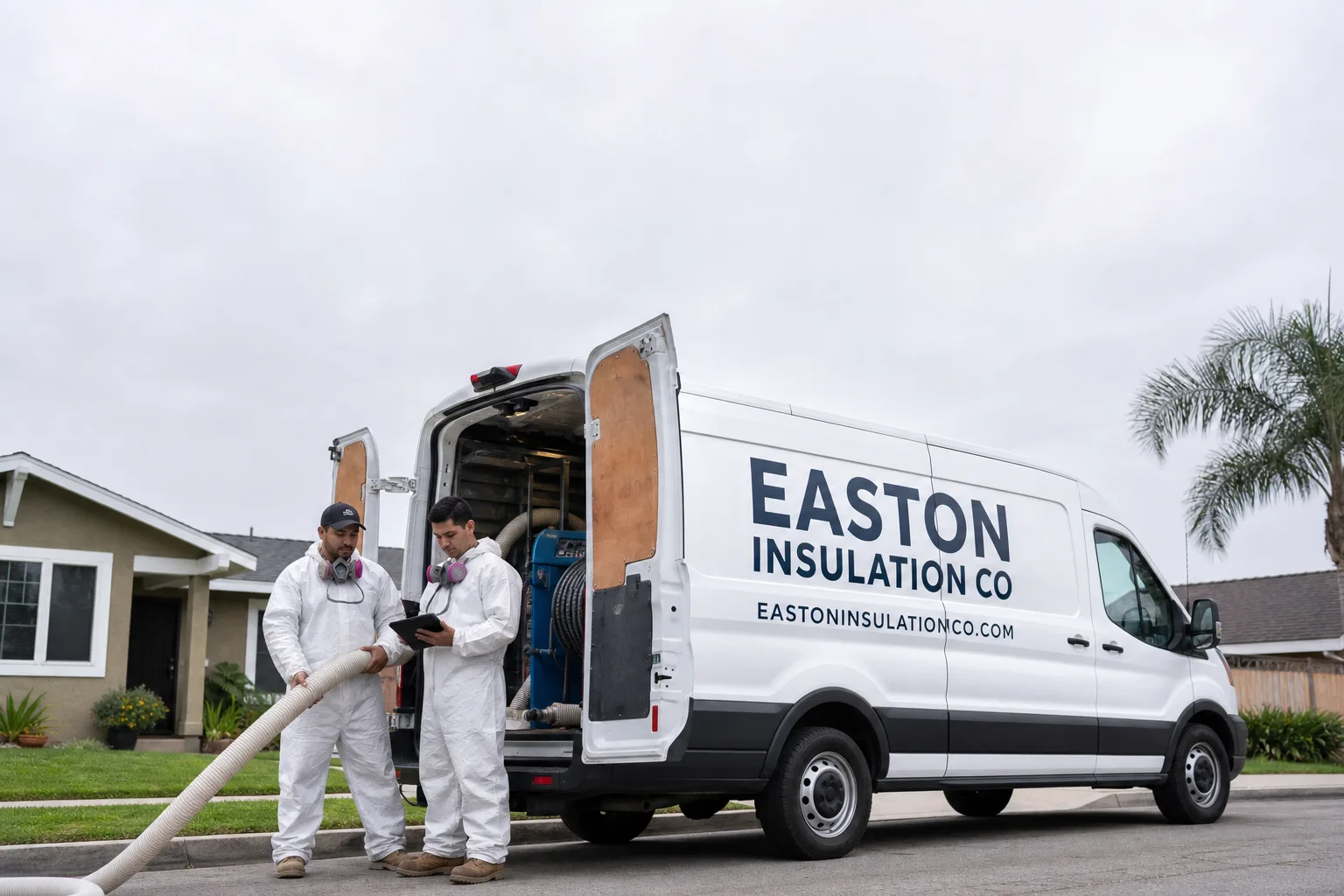
Fast, Reliable Spray Foam Insulation Across San Joaquin Hills
Spray foam insulation in San Joaquin Hills typically runs $2,800 – $8,400 depending on the area treated, and most jobs are finished in one or two days. We work throughout 92657, including the gated enclaves off Newport Coast Drive where architectural review shapes how every vent and penetration gets handled. The marine layer here does something most insulation contractors never account for: it cycles moisture through wall cavities differently on the east and west sides of the same house. Call (833) 467-6922 and we’ll walk you through what your specific home needs before you spend a dollar.
Led by Noel Carrasco, our crew has sprayed foam in enough San Joaquin Hills homes to know which questions the HOA will ask before they ask them. That’s the difference between a job that passes review the first time and one that gets flagged, reworked, and billed twice.
Why Easton Insulation Is San Joaquin Hills’s Preferred Spray Foam Insulation Company
San Joaquin Hills is not a tract neighborhood. The homes here are 1980s – 2000s Mediterranean and Spanish-style customs with stucco exteriors, tile roofs, and vaulted ceilings that make insulation access genuinely difficult. We’ve worked these houses enough to know where the framing runs, where the soffits hide usable cavity space, and which walls the afternoon sun punishes hardest.
We’re an authorized installer for Icynene and Demilec spray foam, and we carry Knauf, Rockwool, and CertainTeed for jobs where spray foam isn’t the right call. That matters in San Joaquin Hills because some projects need closed-cell foam for moisture control, while others need a hybrid approach with mineral wool. A single-brand contractor can’t always make that call honestly. We can.
Noel Carrasco and the team respond to San Joaquin Hills calls quickly – if you’re near Vista Del Mar or up off Ridge Park Road, we’re typically on site within a day or two for estimates. We’ve earned repeat work in this community because we show up knowing the architectural constraints, not learning them on your dime.
Spray Foam Wall Insulation in San Joaquin Hills
Spray Foam Wall Insulation in San Joaquin Hills means working inside stucco-framed walls where the marine layer drives condensation into cavities every single night. We spray either open-cell or closed-cell foam directly into wall assemblies to seal air movement and stop moisture from condensing against sheathing. Homeowners call us when rooms facing the ocean feel damp or when upstairs bedrooms run ten degrees warmer than the rest of the house.
A typical wall cavity spray job in San Joaquin Hills runs $1,900 – $4,600 depending on wall count and accessibility. Closed-cell Icynene foam costs more per board foot but adds structural rigidity and acts as a vapor barrier, which matters in walls that see daily marine-layer moisture.
Handling Vaulted Ceilings and Hard-to-Reach Walls
Many San Joaquin Hills homes have vaulted ceilings with no attic access above them. We spray foam into these cavities through small access points, often working from the exterior or through closets, to avoid cutting drywall. The foam expands into irregular framing and seals air leaks that fiberglass batts never could.
When Wall Foam Replaces Settled Batts
Homes built in the 1980s and 1990s often have fiberglass batts that have settled, compressed, or shifted. In San Joaquin Hills, that settling gets worse with the repeated moisture cycle. We remove or bypass degraded batts and spray foam directly into the cavity, restoring the wall’s thermal performance to modern code levels.
Rim Joist Spray Foam in San Joaquin Hills
Rim Joist Spray Foam in San Joaquin Hills targets the band of framing where the foundation meets the first floor – the single most common air-leak point in the 1980s – 2000s homes that dominate this area. We spray closed-cell foam into each rim joist bay to seal air movement, block crawlspace moisture, and stop the cool damp air that rises from the ground every evening when the marine layer settles in.
Rim joist sealing in San Joaquin Hills typically costs $1,200 – $2,800 for a full perimeter. If you notice cold floors in winter or a musty smell from the crawlspace, your rim joists are almost certainly unsealed. The dampness that collects there is exactly what feeds mold and draws pests.
Why Rim Joists Fail First in Coastal Air
San Joaquin Hills sits close enough to the coast that overnight humidity is a constant. Unsealed rim joists let that damp air into the floor system. Foam applied to rim joists has to bond in conditions that are rarely dry. We test surface moisture before spraying – if we spray onto damp wood, the foam won’t adhere and you’ll get delamination within a year or two.
Crawlspace and Venting Considerations
Homes off Newport Coast Drive often have vented crawlspaces. When we seal rim joists with closed-cell foam, we account for the existing venting scheme so we don’t inadvertently trap moisture. In gated communities, any venting changes must stay invisible from the street, which means routing through existing soffits or matching stucco patches. We’ve done this enough times to know what passes review.
Trusted Brands We Service in San Joaquin Hills
We install Icynene and Demilec spray foam because these two brands perform consistently in coastal moisture conditions, and we’re authorized for both. For hybrid jobs or areas where foam isn’t ideal, we carry Knauf and Rockwool mineral wool, plus CertainTeed fiberglass. If your San Joaquin Hills home needs a mix of closed-cell foam at the rim joists and mineral wool in interior walls, we quote the right products from day one. Parts and materials are stocked locally, so turnaround on San Joaquin Hills projects stays tight. We don’t push one manufacturer’s catalog; we match the material to what your house actually needs in this climate.
Common Spray Foam Insulation Problems We See in San Joaquin Hills Homes
- Marine-layer moisture behind unsealed wall cavities. The nightly fog cycle drives condensation into stucco walls and rim joist bays. If foam was applied over damp substrates or without proper surface prep, it delaminates and silently loses performance.
- Santa Ana wind-driven heat causing poor curing and off-gassing. In hot, dry Santa Ana conditions, open-cell foam sprayed in attics can cure too quickly or off-gas longer. We adjust application rates and timing for San Joaquin Hills weather patterns, something a crew from inland Orange County rarely does.
- HOA violations from visible foam or venting changes. Spray foam that expands through exterior penetrations or vents that get relocated visibly from the street will trigger a review violation here. Homeowners get hit with rework costs and fines. We plan venting and foam application so nothing changes the home’s street-facing appearance.
- Vaulted ceiling cavities with zero access and degraded batts. Older customs in San Joaquin Hills often have vaulted ceilings with no attic above. The original batts settle and lose R-value. Spray foam, applied through small access points, is the only practical fix short of tearing out drywall.
Pricing for Spray Foam Insulation in San Joaquin Hills, CA
Spray foam insulation in San Joaquin Hills runs these typical ranges: wall cavity spray, $1,900 – $4,600; full rim joist sealing, $1,200 – $2,800; attic roof deck spray, $3,500 – $8,400. Access conditions matter here more than most cities – vaulted ceilings and two-story stucco walls add labor, and HOA-coordinated venting work can require extra planning. A small garage ceiling spray might land near the low end; a whole-home air seal with closed-cell foam will reach the high end. Call (833) 467-6922 for a free, specific estimate. We give you a line-item number before any work starts, and nothing gets sprayed until you approve the scope.
We Also Serve Cities Near San Joaquin Hills
Easton Insulation Co runs Spray Foam Insulation crews throughout this stretch of Orange County. If you’re in Newport Beach, Irvine, Costa Mesa, or Laguna Woods, we cover those areas with the same brand range and same straight pricing. For anything specific to San Joaquin Hills, including HOA constraints off Newport Coast Drive, we’re the crew that already knows the landscape.
Serving San Joaquin Hills, CA — Our Local Coverage Area
We’re based in the San Joaquin Hills area and know this community well. Use the map below to see our service coverage — if you’re nearby, we can almost certainly help.
FAQs About Spray Foam Insulation in San Joaquin Hills
Yes, in most San Joaquin Hills communities, any exterior change – including new venting, soffit modifications, or visible penetrations from spray foam application – requires architectural review approval before work begins. Interior-only spray foam applications that don’t alter exterior appearance typically do not need review, but any venting we need to add or reroute does. We prepare the documentation and spec sheets the review board wants, and we plan venting so it’s hidden inside existing soffit cavities or matched to the original stucco and tile details. Call (833) 467-6922 and we’ll tell you whether your specific project needs a filing.
We access vaulted ceiling cavities through small openings – usually from the exterior, through closet ceilings, or through existing can light holes – and spray foam into the cavity with an injection wand. The foam expands to fill irregular framing, then we patch the small access point. In San Joaquin Hills homes with 1980s – 2000s vaulted ceilings, this is almost always the right approach because cutting and replacing large drywall sections on a vaulted surface is expensive and rarely matches the original texture. If your ceiling has never been insulated properly, this method usually brings the biggest comfort jump per dollar.
Closed-cell foam from Icynene or Demilec is the strongest choice for San Joaquin Hills’ marine-layer exposure because it acts as a vapor barrier and won’t absorb the nightly moisture the way open-cell foam can. For rim joists, crawlspaces, and any cavity exposed to outside dampness, we specify closed-cell. Open-cell foam still has its place in interior walls and soundproofing applications, but in this specific climate the closed-cell product earns its cost. We’ll tell you where each makes sense, and we won’t sell you closed-cell where it’s overkill.
Yes, open-cell spray foam in shared or street-facing walls reduces sound transmission noticeably, which matters in San Joaquin Hills where homes sit close together on hillside lots and HOA rules limit some exterior modifications. Open-cell foam in wall cavities absorbs sound far better than fiberglass batts, and it also seals the tiny air gaps that let sound travel between units or from the street. If you’re hearing road noise from Newport Coast Drive or voices from a neighboring lot, spray foam in the affected wall is one of the few retrofits that helps without changing anything visible from the street.
We route new venting through existing soffit cavities, attic spaces, or behind existing architectural details so nothing new appears on the street-facing elevation. When a penetration must be created, we cut it from a non-visible elevation, match the stucco patch to the original finish, and document everything for architectural review. In gated San Joaquin Hills communities, we’ve passed HOA review without revisions by submitting before-and-after photos and spray foam spec sheets up front. The goal is that after we finish, the house looks exactly as it did before – just tighter and quieter inside.
Call Easton Insulation Co for Spray Foam in San Joaquin Hills
If your San Joaquin Hills home leaks air, fights the marine layer, or just won’t hold temperature, call (833) 467-6922 for a free estimate. Noel Carrasco and the crew will walk the property with you, explain what’s happening in the walls and rim joists, and give you a line-item number before any foam gets sprayed. We work with Icynene, Demilec, Knauf, Rockwool, and CertainTeed – so the recommendation is always about your house, never about a single brand’s catalog.
Written by Noel Carrasco, Owner at Easton Insulation Co, serving San Joaquin Hills and greater Orange County.